What changed in six months? A preregistered look
Agent quality over time showed that pushback fell. Here we ask what else changed in how the researcher works with agents, as scientists would. The hypotheses and the analysis plan were written down and committed before any of these measures were computed. Then they were tested, and the surprising results were checked before being believed.
Data: about 2,000 of the researcher's messages to Claude Code on an HPC cluster, May–October 2026 (April has too few to test), plus a second machine (September–October only) as a replication, plus git history.
Methods: - Deterministic measures straight from the transcripts: tool calls, subagent use, tests and builds run, edits to instruction files, git activity. - A cheap model (Haiku) labelling each message, checked against a larger model (Sonnet) on 150 messages per task. - Early (May–June) vs late (September–October) comparisons, with a trend test and a multiple-comparison correction.
Scorecard
| # | Hypothesis (as preregistered) | Result | Verdict |
|---|---|---|---|
| H1 | "Are you sure?" challenges fall; outright corrections don't change | Challenges 30% → 17% (p ≈ 10⁻⁷); corrections 17% → 15% | Supported |
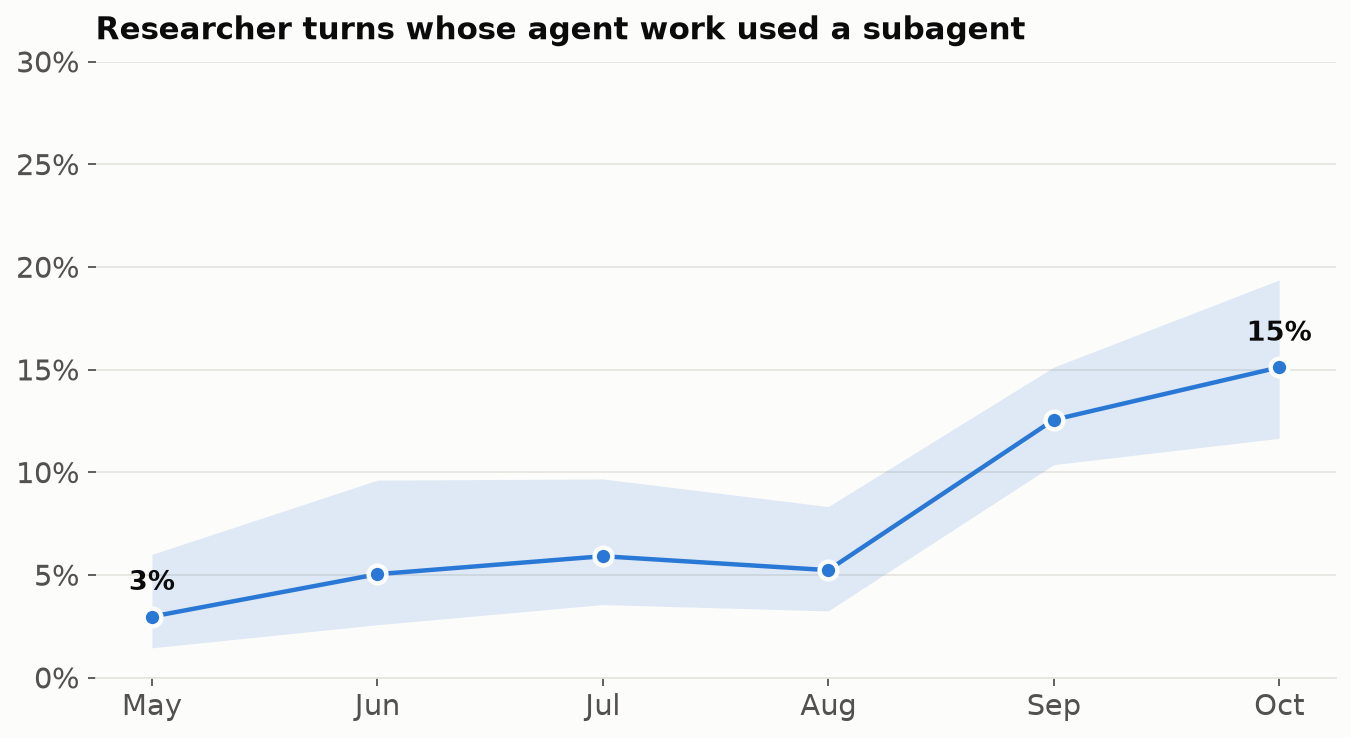
| H2 | Delegation rises on at least 3 of 4 channels | Subagent use more than tripled (p ≈ 10⁻⁷); Codex hand-offs barely; background jobs fell; cross-session dispatch absent on this machine | Not supported as written (one strong channel) |
| H3 | More "done" claims come with evidence | The automatic proxy fell, 28% → 15%, but that shrinks to n.s. once checks done inside subagents are allowed for. A manual audit of 60 claims found real evidence in 67% (early) vs 50% (late), n.s. | Inconclusive. The robust part is the level: about half of "done" claims come with evidence |
| H4 | Errors fixed by a hook or guard recur less than errors fixed by a memory note | Zero genuine hook edits in the data. Memory notes: same-thread recurrence 37%, the same as the random baseline (37%). Test and guard edits are followed by more local recurrence (59%), most likely because tests get written where errors cluster | Not testable. No sign that memory notes reduce recurrence |
| H5 | Responses to errors shift from re-explaining to structural fixes | Structural responses flat at about 60–67%; re-explaining flat at about 26% | Not supported |
| H6 | More output | Commits roughly doubled (Jan–Feb about 120 a month → Sep 221). The share co-authored by Claude went from about 2% to 70–90%. Turns with git activity: 11% → 31% | Supported on a weak proxy |
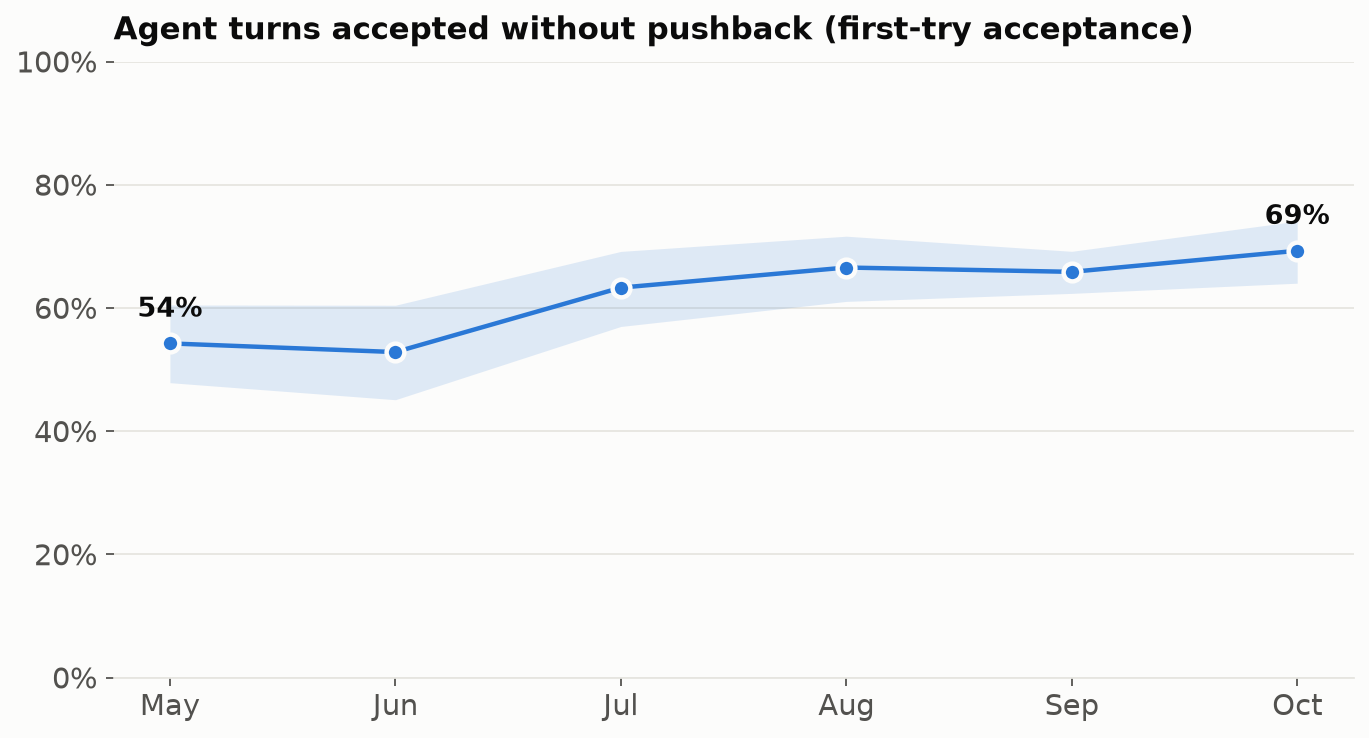
| H7 | More agent turns accepted first time | 54% → 69% (p ≈ 10⁻⁶); rework chains shorter | Supported |
How the researcher's own behaviour changed (exploratory)
Each message was tagged against a codebook of about 30 behaviours from the pattern catalogue. Six codes that the two models disagreed on (κ < 0.4) were dropped. This is hypothesis-generating, not tested.
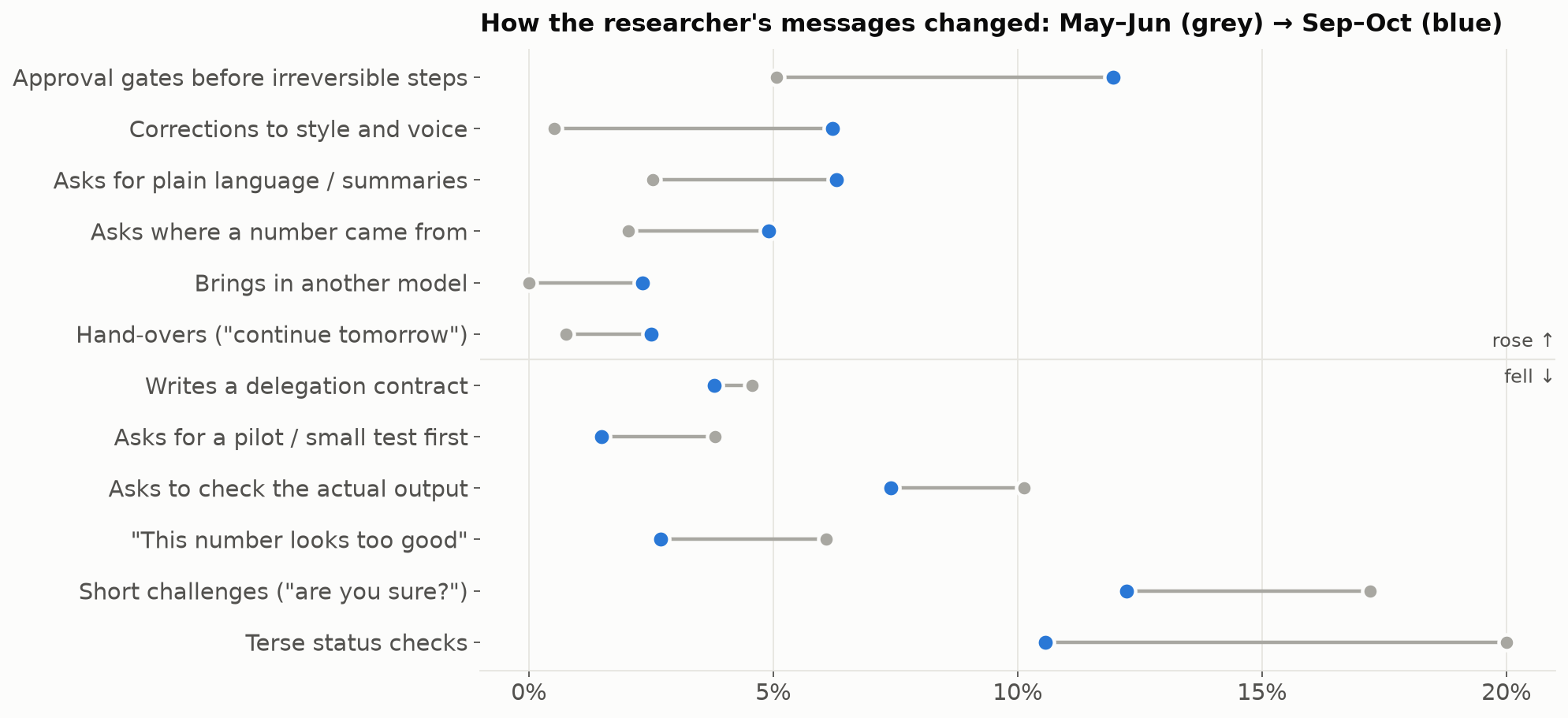
Reading: - Less policing. Fewer status checks, fewer "are you sure?" challenges, less "this number looks too good", less "show me the output". - More governing. More approval gates before irreversible steps, more provenance questions, more hand-overs, more cross-model work. - And more editing. Corrections to style and voice, and requests for plain language, rose sharply.
The kind of error changed
Among messages implying an agent mistake (labelling agreement is only borderline here, κ ≈ 0.49, so treat this as indicative):
| Error type | May–Jun | Sep–Oct |
|---|---|---|
| Didn't run or verify | 27% | 16% |
| Claimed done falsely | 15% | 10% |
| Misunderstood what was wanted | 14% | 23% |
| Style or verbosity | 5% | 19% |
| Ignored an instruction | 8% | 8% |
| Physics or maths error | 2% | 2% |
Execution errors fell; errors of intent and taste rose. Six months in, the bottleneck is less "did it do the work correctly?" and more "did it understand what I wanted, and say it the way I want?"
What we learned about doing this
- Two of the first-pass "reversals" were measurement artefacts. One test was saturated: almost every error type recurs within 14 days anyway. The other had a blind spot: checks done inside subagents were invisible. Both were caught by applying a surprising number is a bug first to our own results.
- Preregistering made the failures visible. Without it, H2, H4 and H5 would have quietly disappeared from the story.
- Confounds: model, month, project and the researcher's own skill all move together. This is a study of one person's working practice, not of models.
See methodology for the label validation and pipeline.